
Sicily to Live: A Journey Through Places, Culture and Caltagirone Ceramics
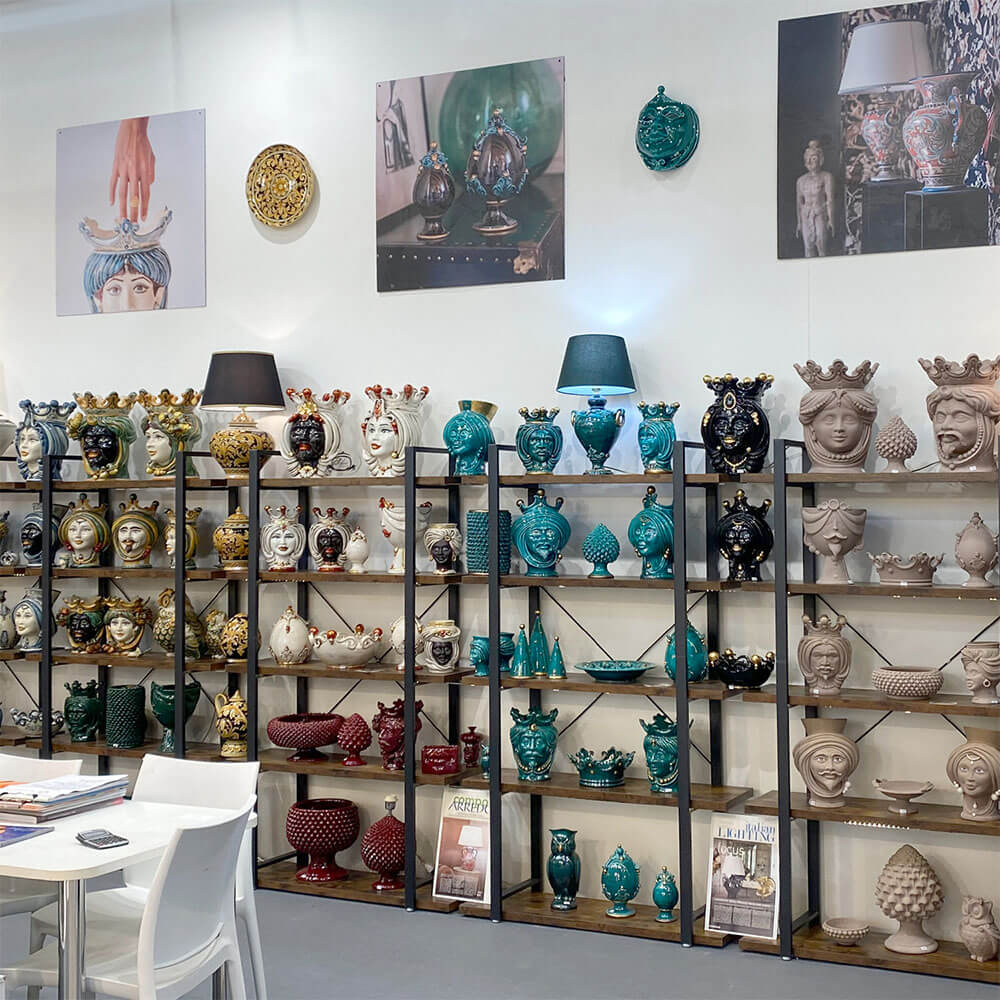
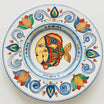
There is a way of looking at Sicily that has nothing to do with crowded beaches or postcards. It begins with a hand-painted plate resting on a kitchen table, with the deep blue of a piece of maiolica (majolica), with the proud face of a Testa di Moro (Moor's head) looking out from a balcony. Sicily tells its story this way too: through its ceramics, which preserve the colours, the legends and the hands that shaped this island.
This is a journey through the places, the culture and the works born in Caltagirone, the town that lends its name to one of the oldest craft traditions in the Mediterranean. An itinerary for those who dream of Sicily, for those who have already loved it and want to bring home a fragment of it, and for those who work with beauty every day: architects and designers looking for authentic pieces to bring into their projects.
Sicily, a Mosaic of Cultures
Few lands in the world have changed hands as often as Sicily. Greeks, Romans, Byzantines, Arabs, Normans, Swabians, Spaniards: each left something behind, and nothing was ever lost. This layering is the island's true signature. You find it in the architecture, in the language, in the cuisine, and above all you find it in its applied arts.
The Greeks arrived first with their temples and their myths, and here myth was never only a story: it became form, decoration, an everyday object. The Arabs, between the 9th and 11th centuries, brought citrus fruits, irrigation systems and, most relevant to us, the glazing techniques that would forever transform the island's ceramics. The Normans fused Arab elegance with Romanesque solidity, as the mosaics of Monreale show. The Spaniards, finally, left behind the Baroque taste that still defines entire towns today.
In ceramics this encounter is visible to the naked eye. The shape of a vase may echo classical Greek restraint, while the gleaming glaze and vivid colours come straight from the Arab world. Geometric patterns live alongside floral motifs, the figures of myth alongside the good-luck symbols of the Mediterranean. Every piece of maiolica is, in miniature, a map of this shared history.
Understanding this weave is the key to understanding Sicilian ceramics. This is not just another "typical" product: it is the sediment of fifteen centuries of cultural exchange, condensed into a vase or a tile.
Caltagirone, Capital of Sicilian Ceramics
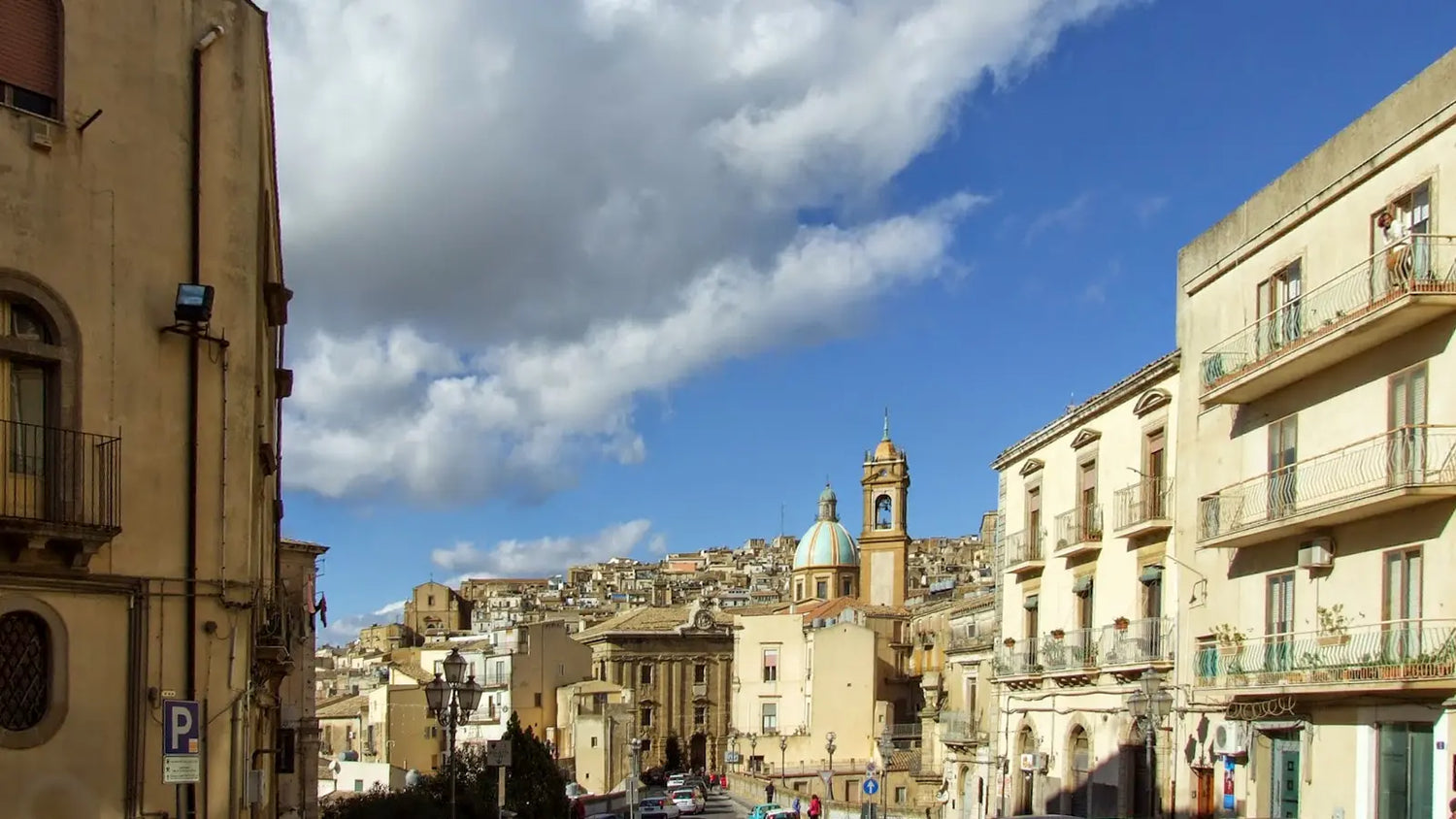
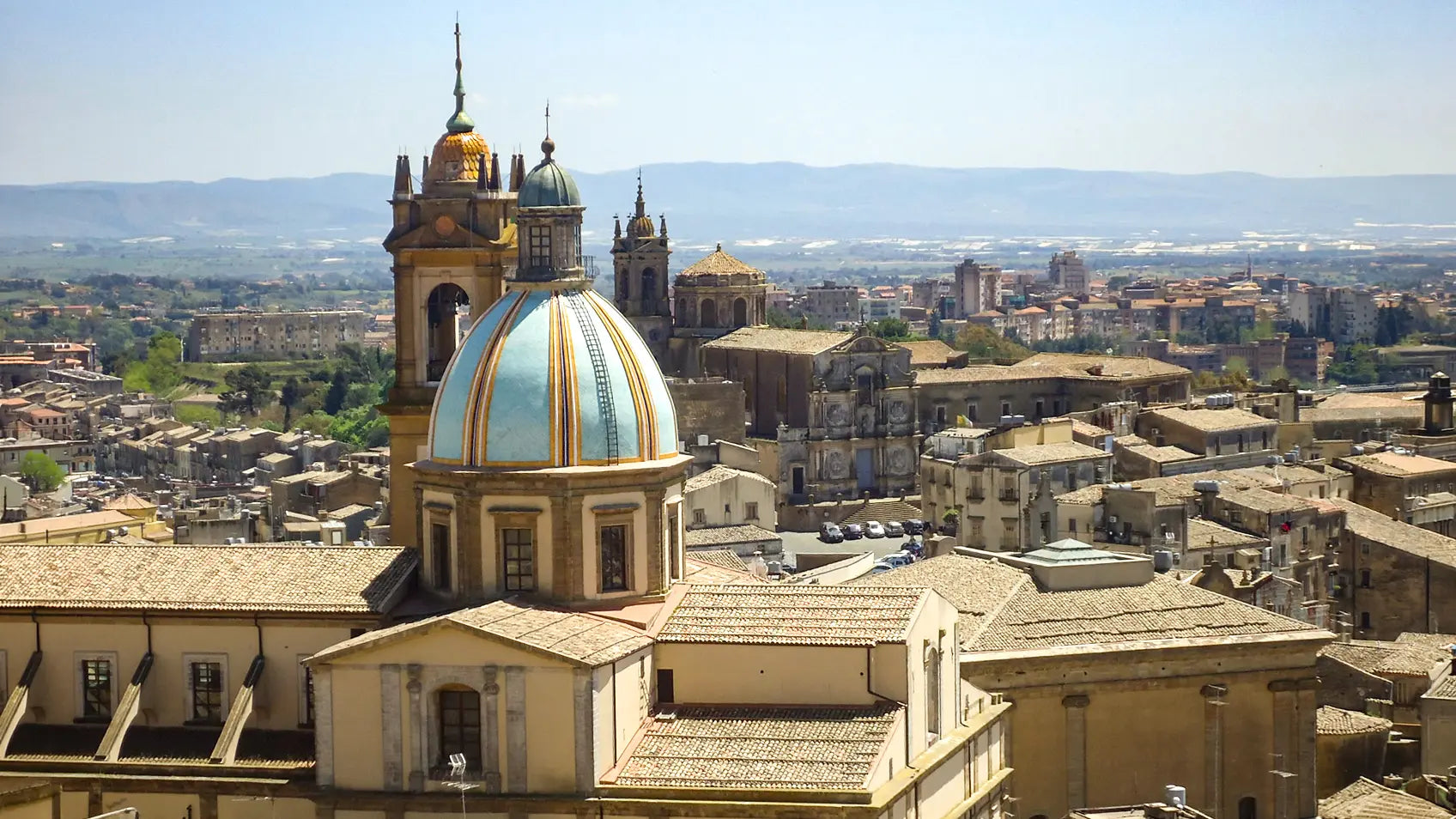
If Sicily is the land of ceramics, Caltagirone is its undisputed capital. It rises inland, halfway between Catania and the agricultural heart of the island, perched on three hills. Its very name betrays its calling: it comes from the Arabic Qal'at al-Ghiran, the "fortress of vases". It was the Arabs, after the conquest of 827, who named it this way, acknowledging a ceramic activity that had already existed here for millennia.
Why Caltagirone in particular? For a reason as simple as it is decisive: the earth. The Calatino territory is rich in high-quality clays, the raw material that has fed production since the Neolithic. On this ancient foundation came the real technical revolution, brought by the Arabs from the 9th century onward: glazing and enamelled maiolica. It was then that the colours destined to become a hallmark recognisable across the world appeared (yellow, blue, copper green), obtained from metal oxides that, during firing, vitrify into glossy, brilliant surfaces.
Since then, the history of Caltagirone and that of its ceramics have never parted ways. The town has weathered earthquakes and rebuildings, has watched workshops rise and fall, but the craft has endured, passed from hand to hand. Today, strolling through the old town means stepping into an open-air museum, where every staircase, every railing, every façade tells the same passion.
Read more → Caltagirone in a day: what to see in the capital of ceramics
The Staircase of Santa Maria del Monte
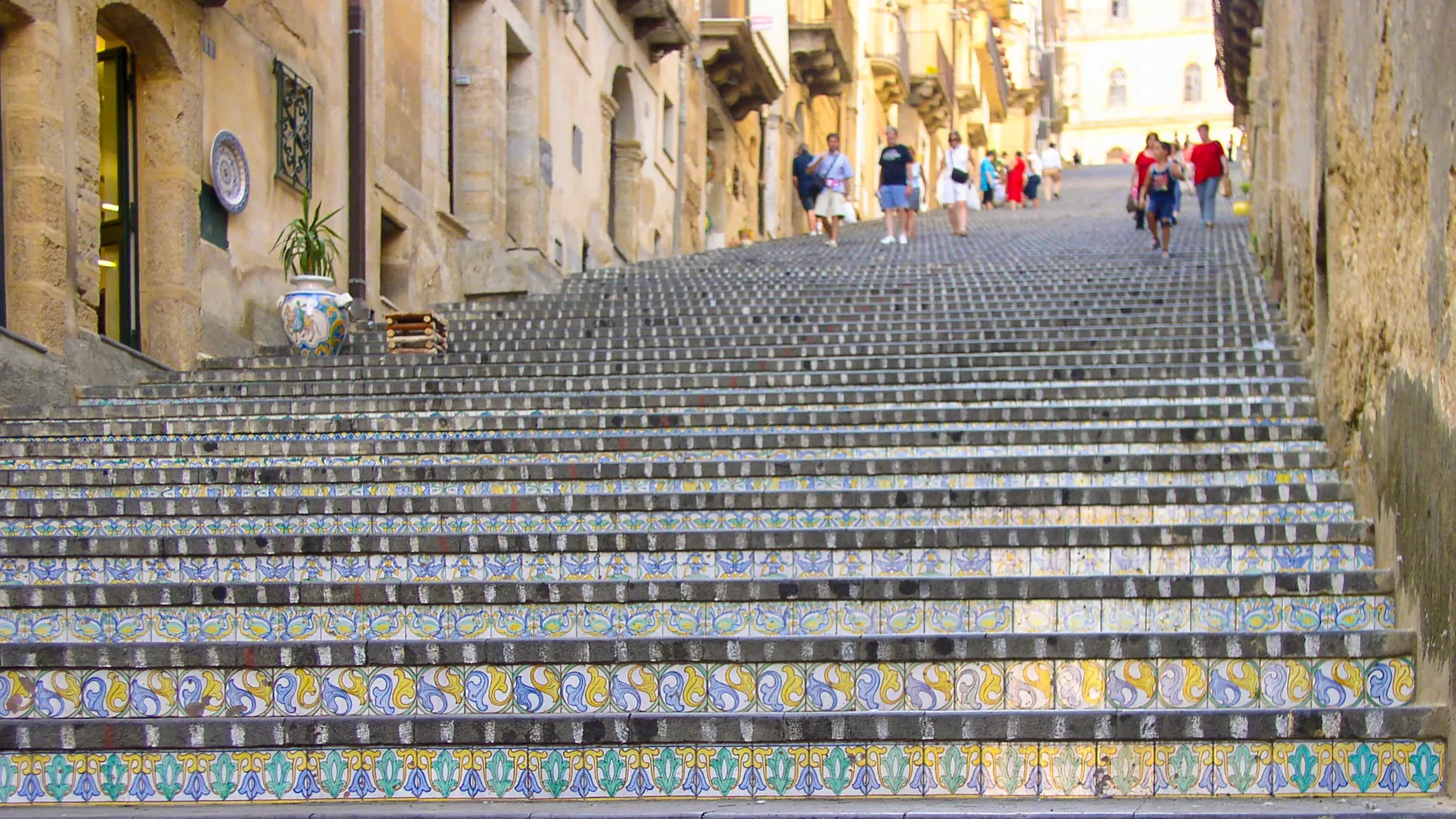
If a single place had to sum up Caltagirone, it would be its monumental staircase. The Staircase of Santa Maria del Monte was created in 1606 to connect the lower old town to the new town growing on the hillside. At first it was a series of separate flights; only in 1844, to a design by the architect Salvatore Marino, were the flights unified into the 142 steps we admire today, stretching more than a hundred and thirty metres.
But its fame came later. Since 1954 the risers of the 142 steps have been clad in polychrome ceramic tiles, an idea that turned a staircase into a walkable work of art. The decorative motifs were gathered and adapted by Antonino Ragona and retrace the very history of Sicilian maiolica: you climb through the Arab-Norman decorations of the first steps, then the Aragonese and Baroque ones in the middle section, up to the contemporary motifs at the top. Climbing the Staircase is, quite literally, climbing through ten centuries of art.

Twice a year the staircase dresses up for celebration. In May, with the Scala Infiorata (flowered staircase), the steps become a single vast painting made of thousands of flower pots. In July, for the Luminaria di San Giacomo (illumination of Saint James), the town's patron saint, thousands of small lamps trace glowing images all the way up the climb. These are the moments when Caltagirone shows who it truly is.
Read also → Caltagirone: a treasure in the heart of Sicily
From Earth to Vase: How a Piece of Maiolica Is Born
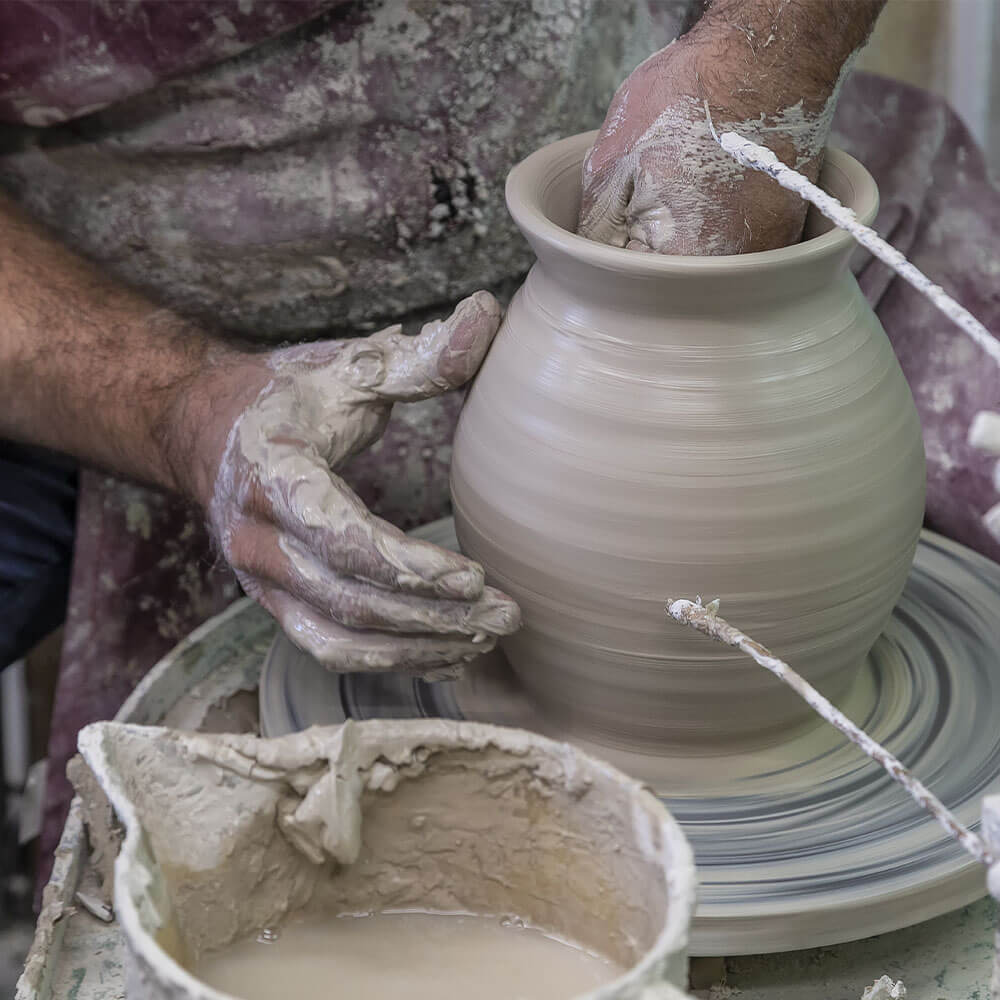
Behind every piece there is a process that has changed little over the centuries and that demands time, skilled hands and patience. It all begins with clay, worked and purified until it becomes malleable. On the wheel, or through moulding, the form takes shape: a vase, a plate, a head. Then comes the slowest part, the drying, which must happen calmly to avoid cracks.
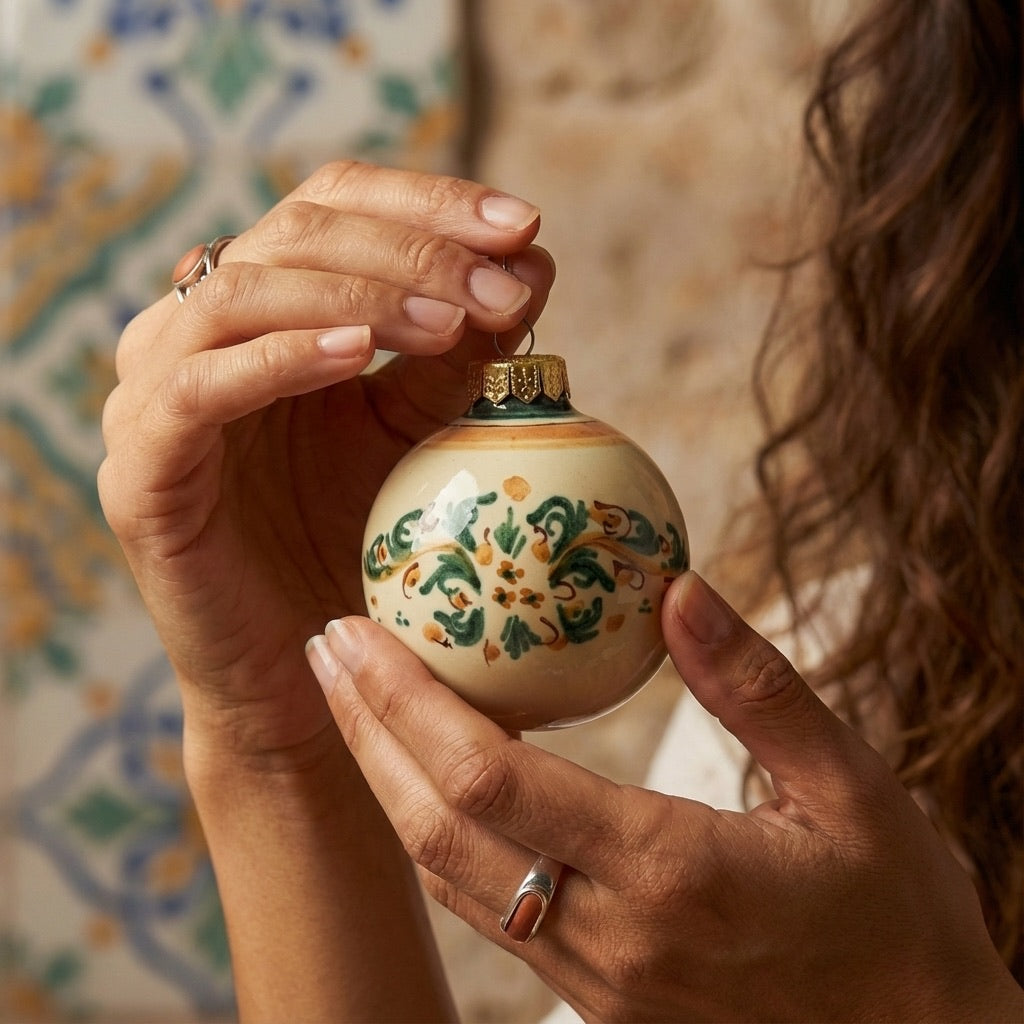
Next is the first firing, the biscottatura (bisque firing), which makes the piece porous and ready to receive colour. It is at this point that the glaze comes into play: the surface is dipped or coated with a mixture that, during firing, vitrifies into a glossy finish. On the still-raw glaze the artisan hand-paints the decorations, with brushes and metal oxides. There is no going back here: the colour is absorbed and every brushstroke is final. The last firing, at high temperatures, fixes the pigments and gives the maiolica the brilliance that makes it unmistakable.
It is a cycle that can last days and passes several times through the hands of the same person. And this is exactly why no two pieces will ever be identical: each carries the gesture of the person who made it, and with it a small, unrepeatable part.
Read more → From earth to vase: how a ceramic work is born · The stages of production →
The Symbols That Tell the Island's Story
Anyone who comes close to Sicilian ceramics soon meets three recurring figures. They are not simple decorations: they are symbols with centuries of history behind them, and knowing them changes the way you look at every single piece.
The Teste di Moro
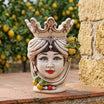
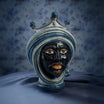
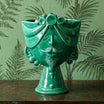
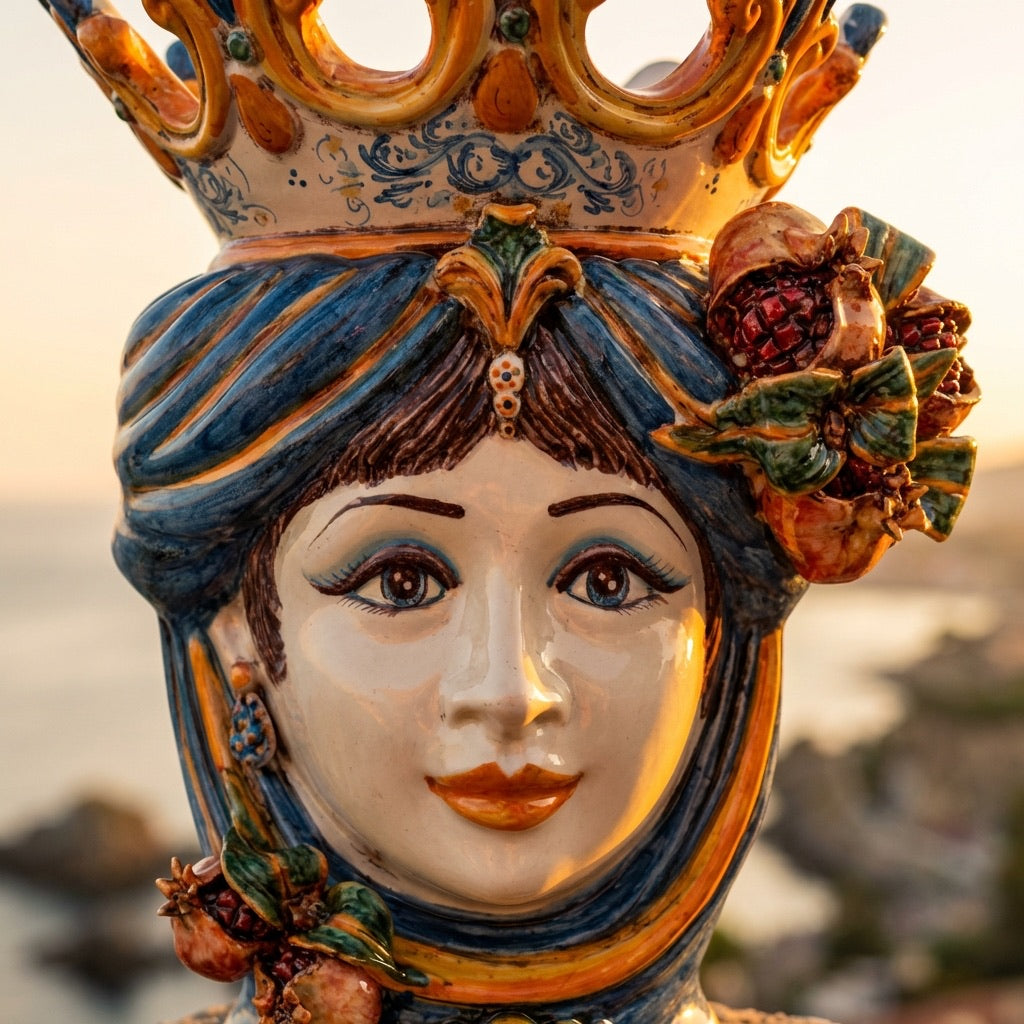
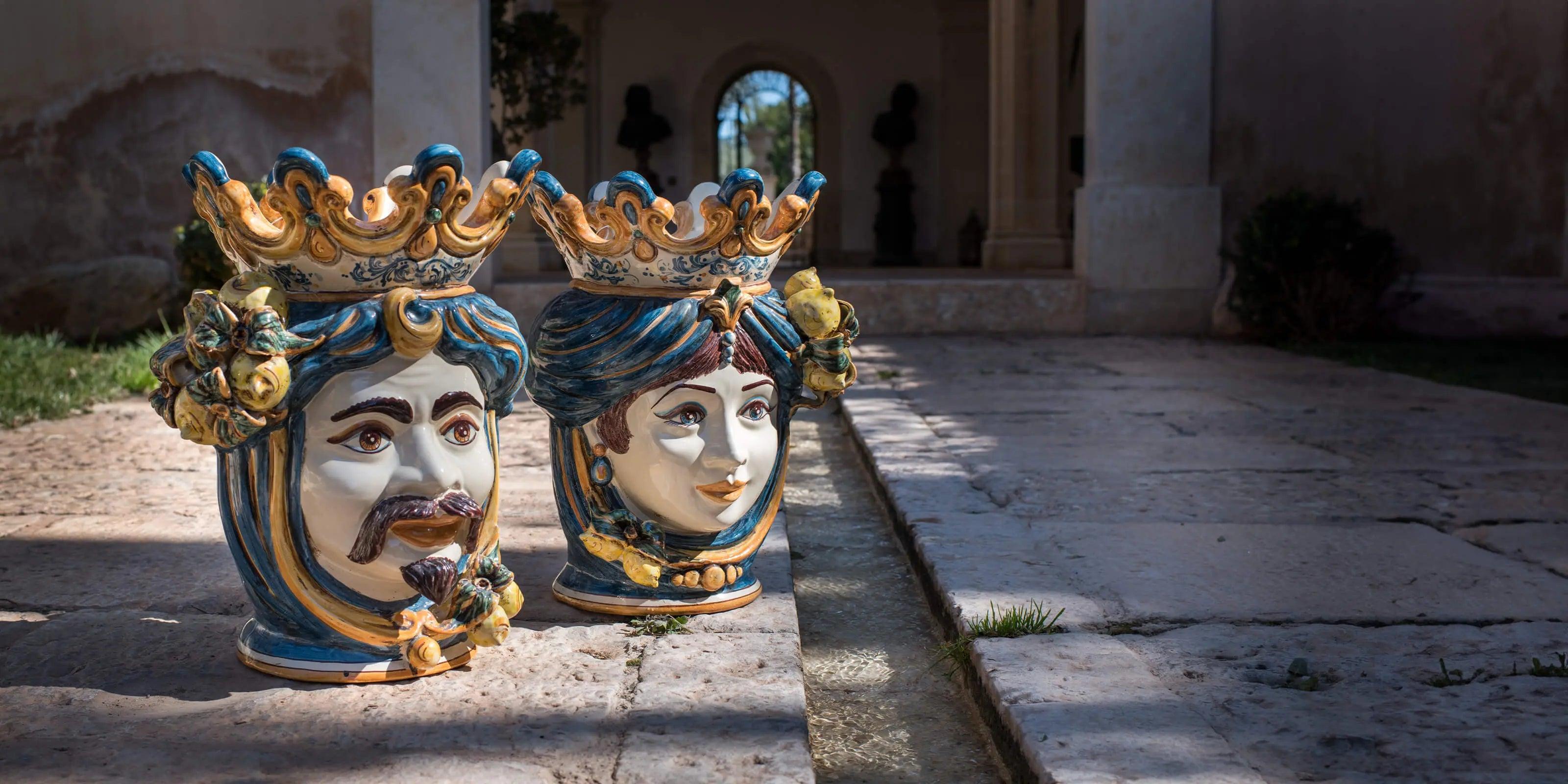
They are perhaps the most recognisable icon of Sicily: two ceramic faces, one of a man with Moorish features and one of a young woman, often turned into vases and displayed on balconies. Behind their beauty lies a legend rooted in the Palermo of the Arab period, in the Kalsa quarter.
The story tells of a young Sicilian woman who lived shut away at home, devoted to her plants. A Moor, passing by, fell in love with her and was loved in return. But when the girl discovered that the man already had a wife and children, and that he would soon return to the East, she decided that this love would not slip away from her: she waited for night and cut off his head, turning it into a vase from which she grew basil. The fragrance drew the envy of the neighbours, who began to make terracotta heads to imitate her. A dark and passionate story, which the Teste di Moro carry with them today as a reminder of Sicilian intensity.

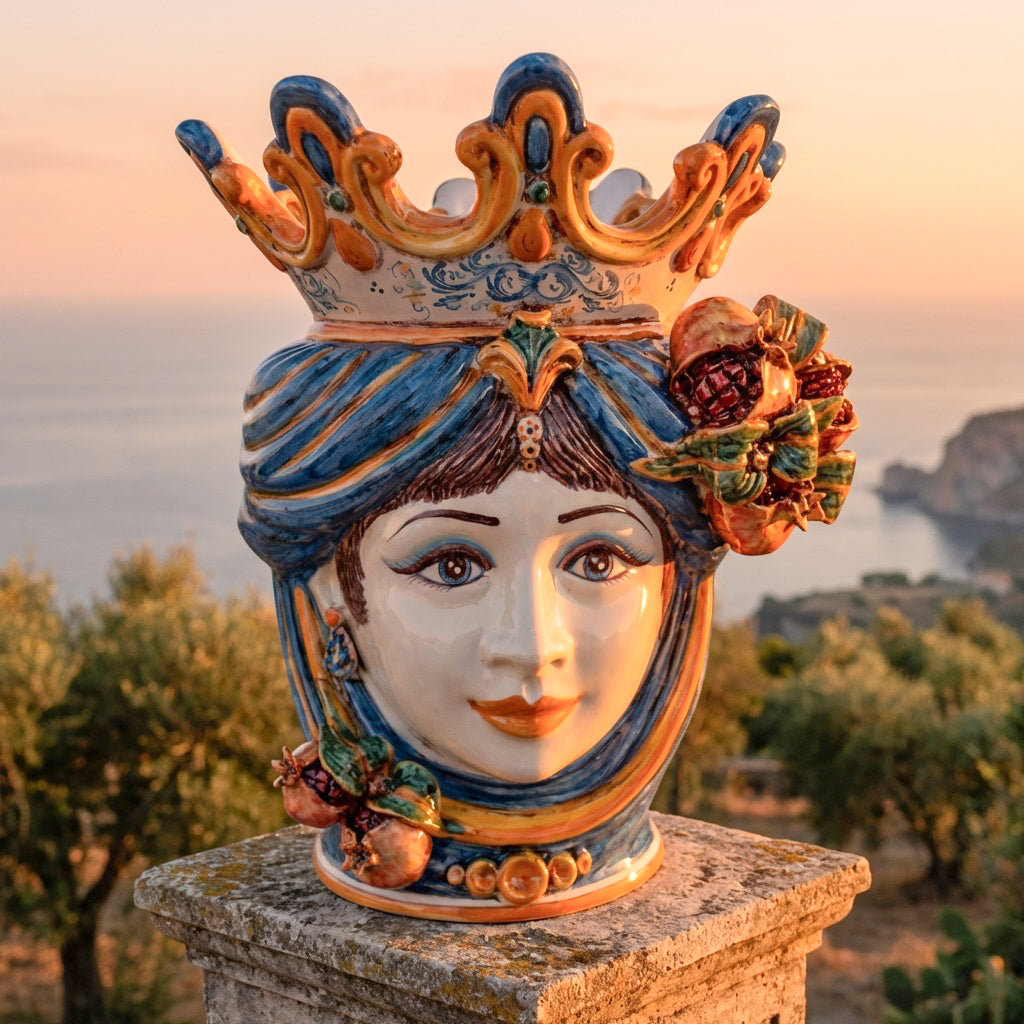
Sicilian Moor's Head with Pomegranates H 40 cm / 15.7", Moro Man, Green and Orange – Testa di Moro from Caltagirone, Sicily
Acquista ora
Testa di Moro Vase with Pomegranates H 40 cm / 15.7", White Man, Green and Orange – Testa di Moro from Caltagirone, Sicily
Acquista ora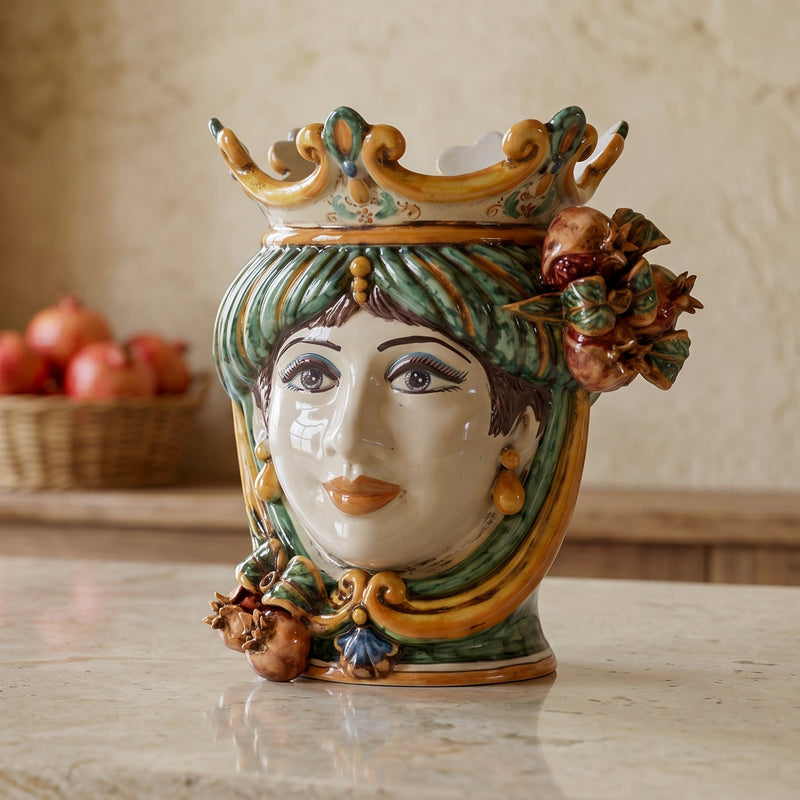
Sicilian Head Vase with Pomegranates H 25 cm / 9.8", Woman, Green and Orange – Testa di Moro from Caltagirone, Sicily
Acquista ora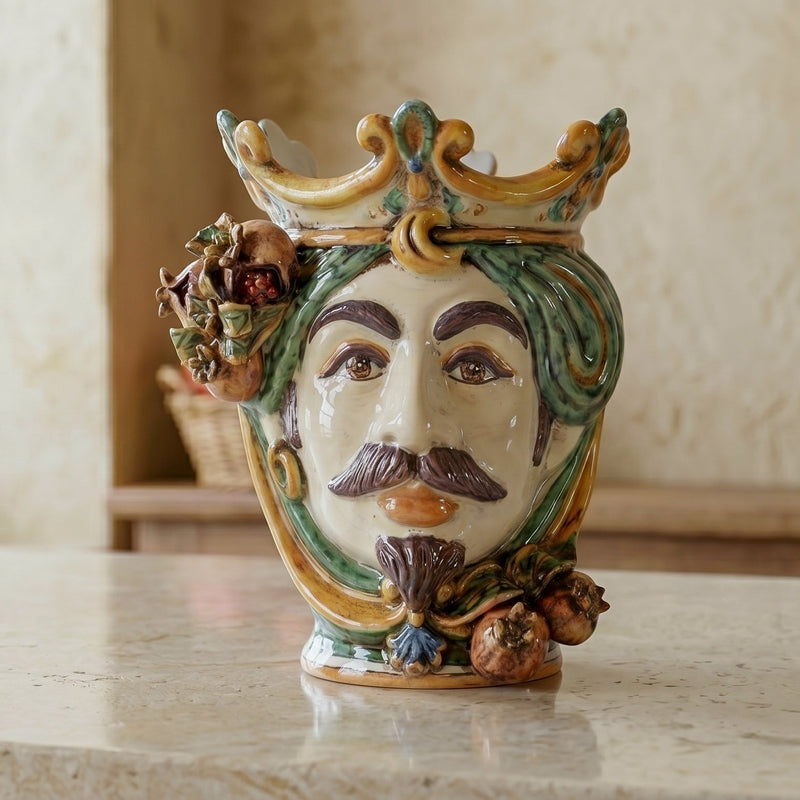
Sicilian Head Vase with Pomegranates H 25 cm / 9.8", White Man, Green and Orange – Testa di Moro from Caltagirone, Sicily
Acquista oraRead more → Teste di Moro: legend, meaning and use in décor · Discover the Teste di Moro collection →
The Sicilian Pigna
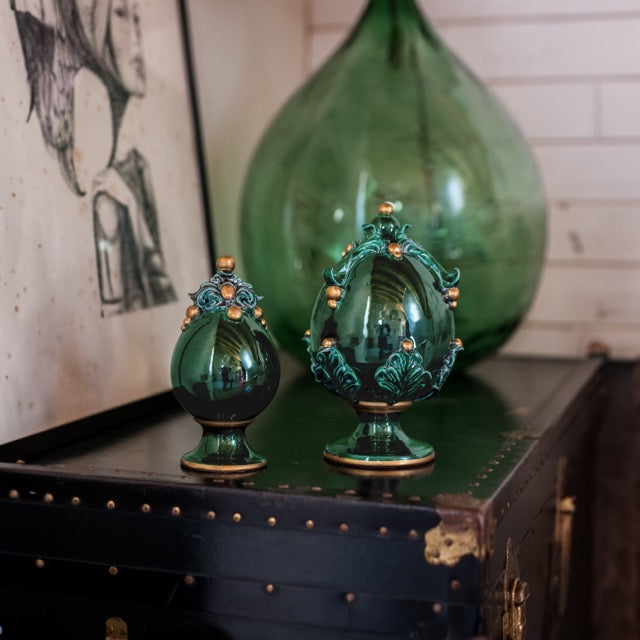
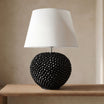
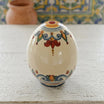
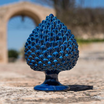
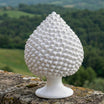
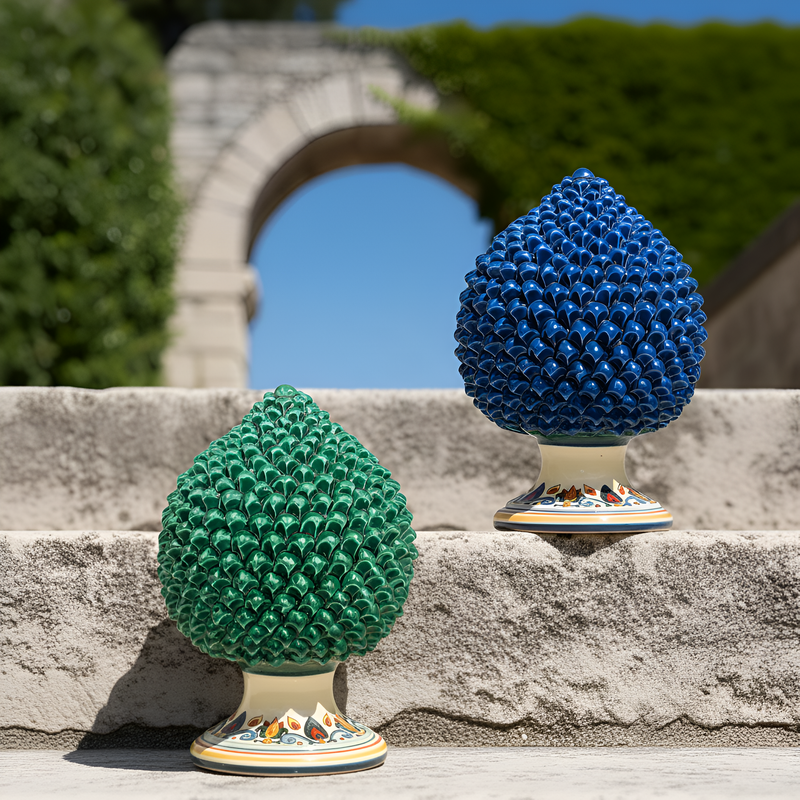
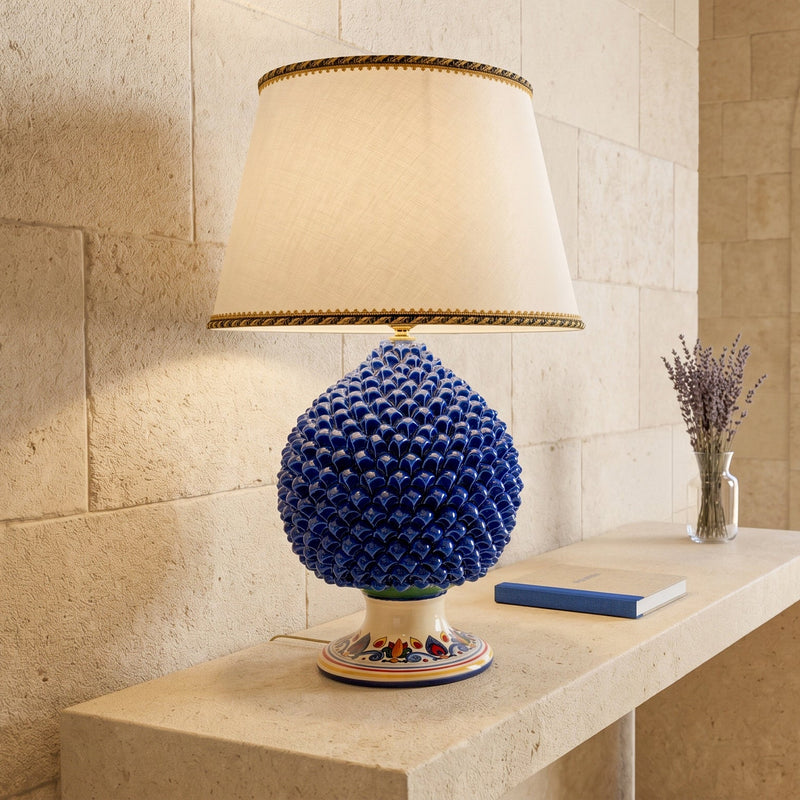
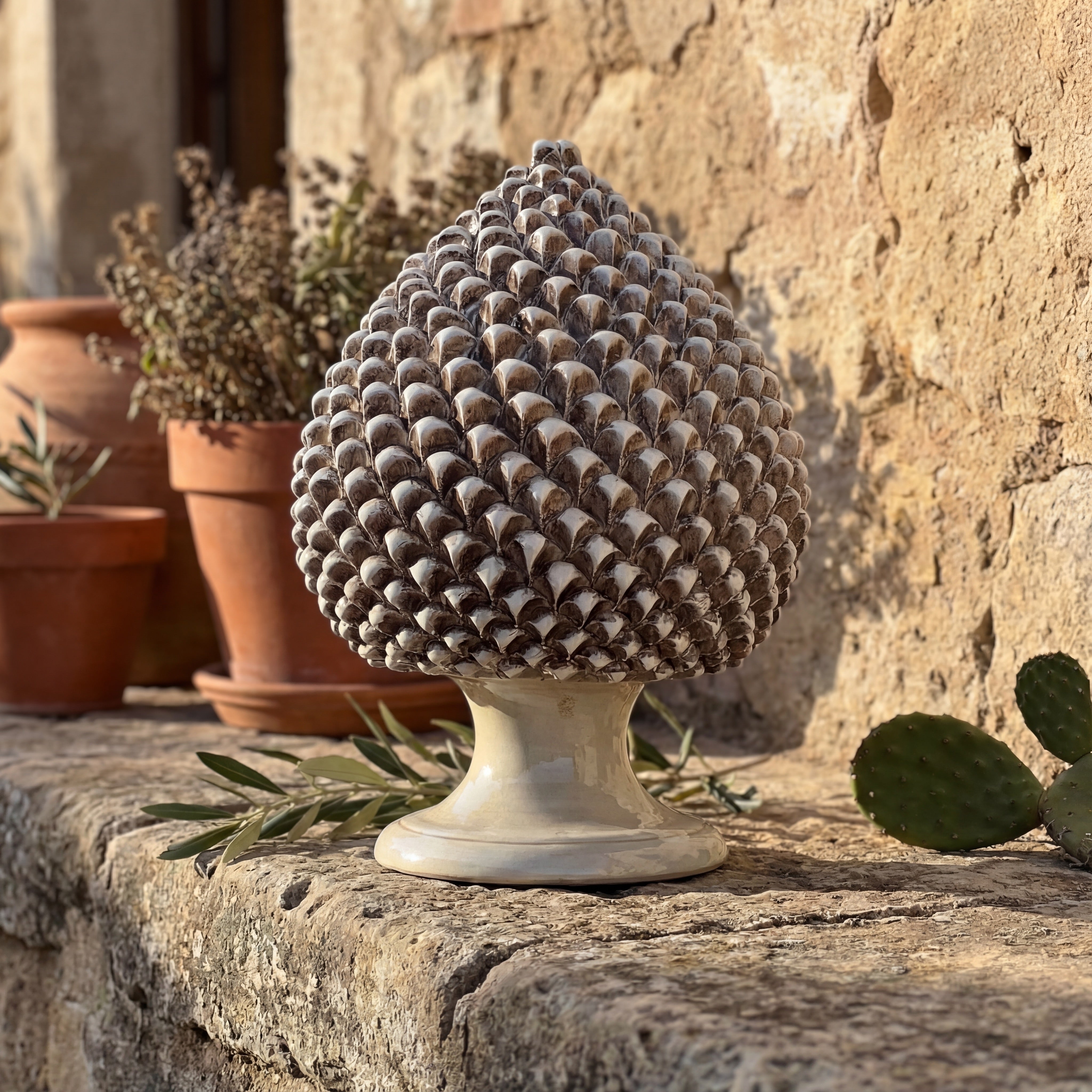
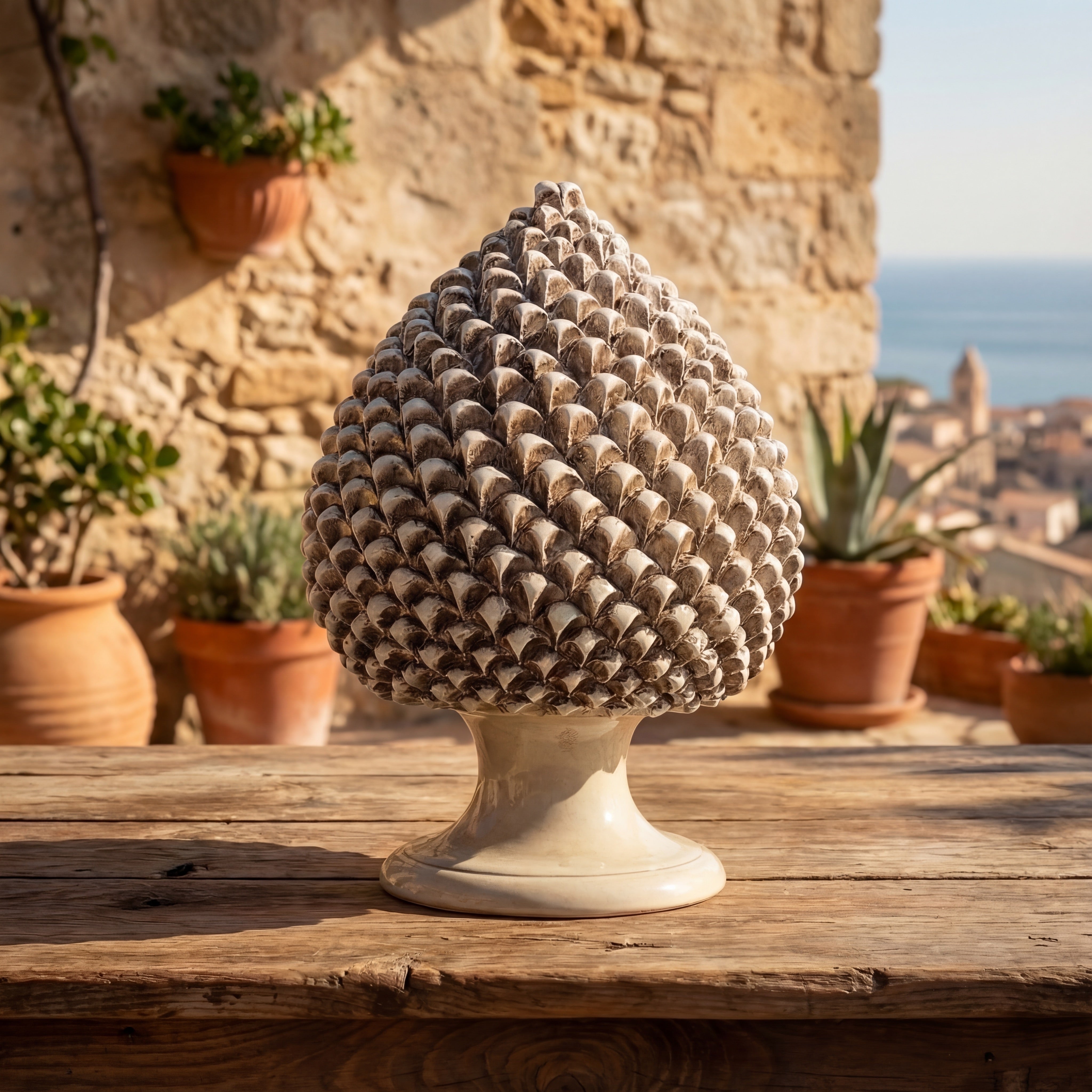
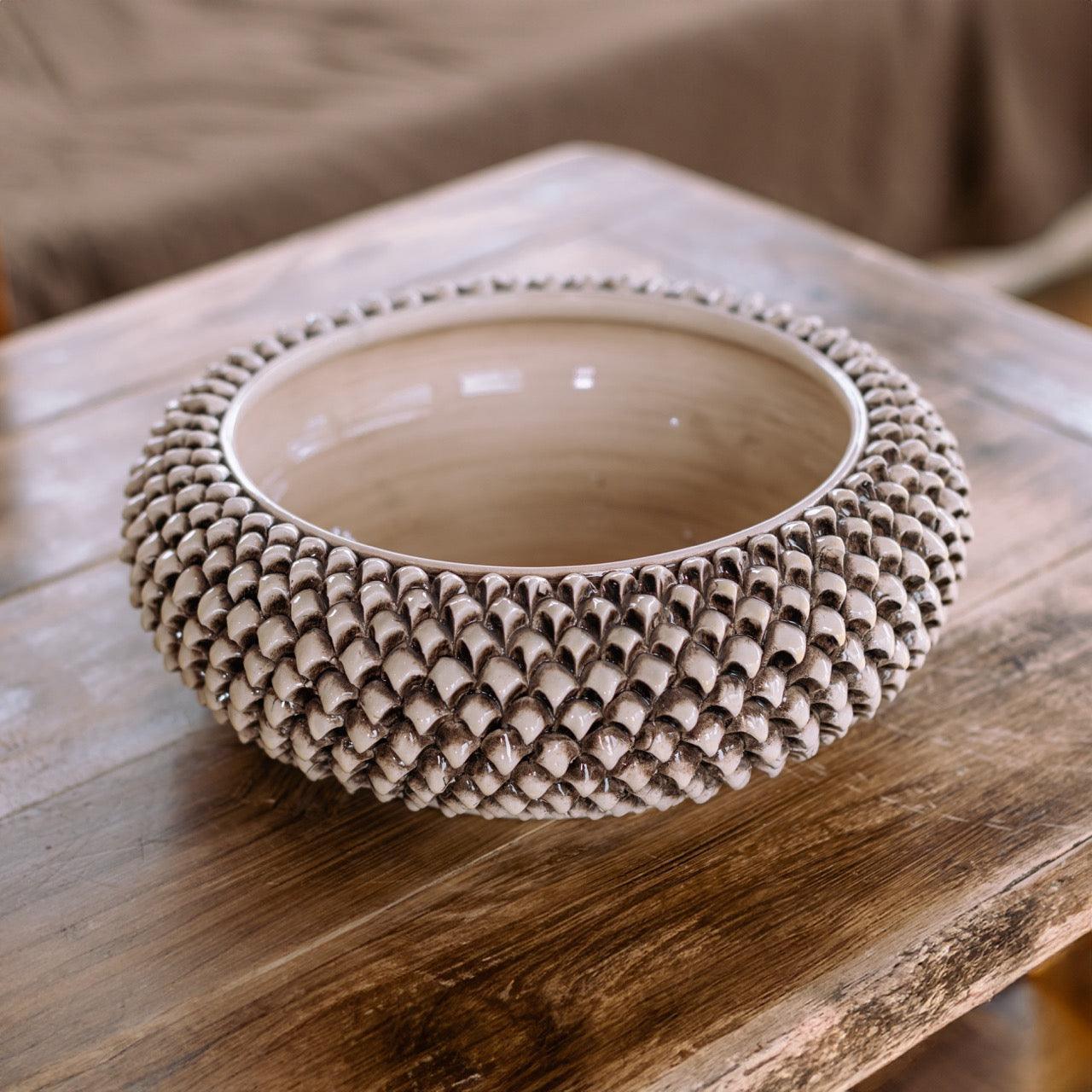
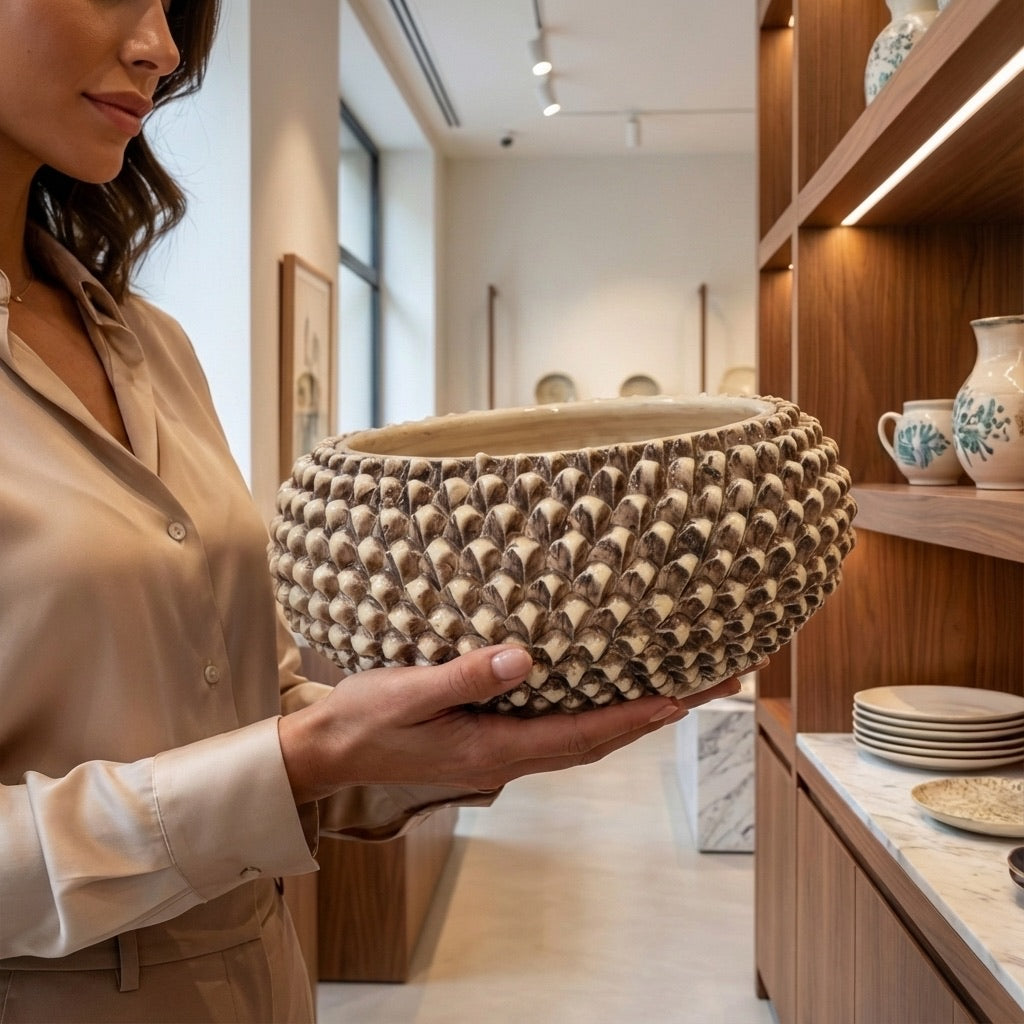
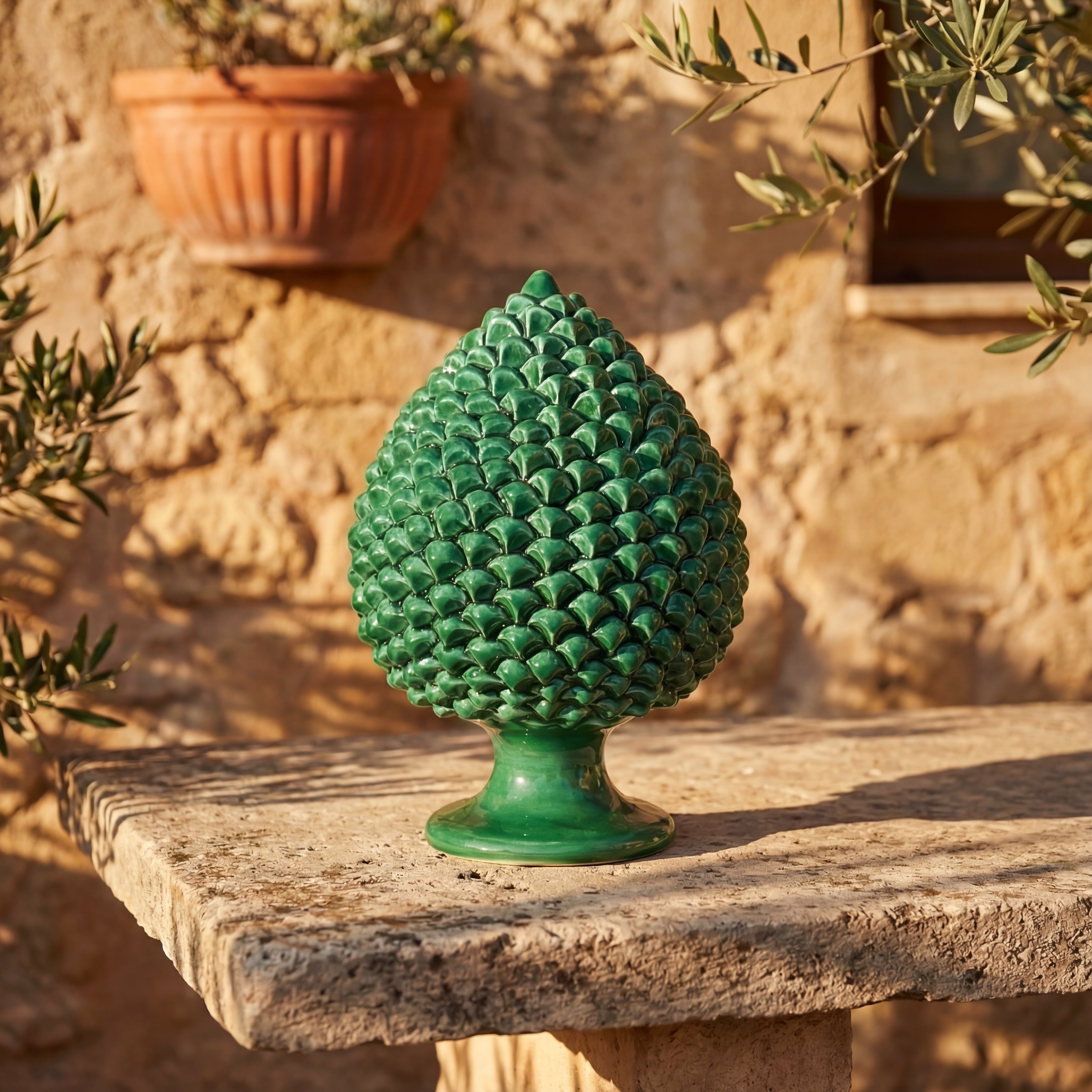
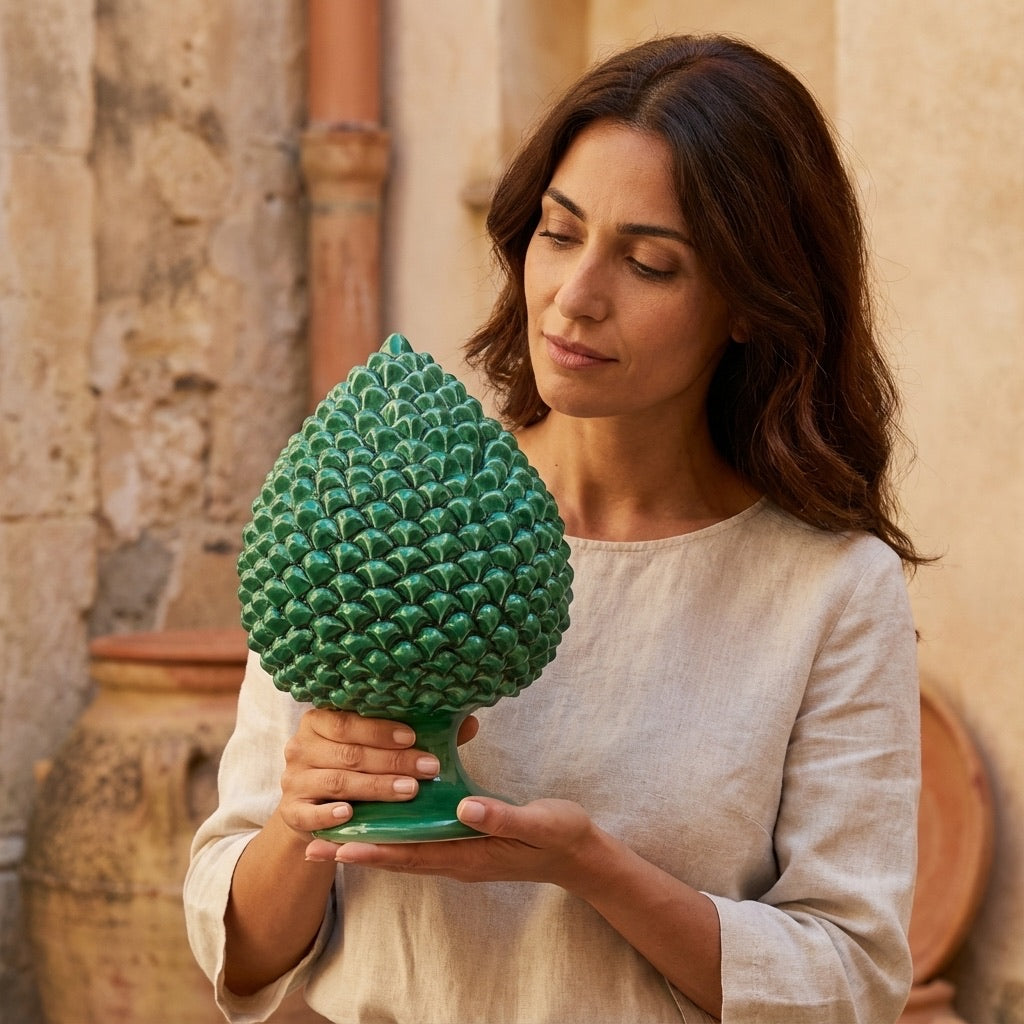
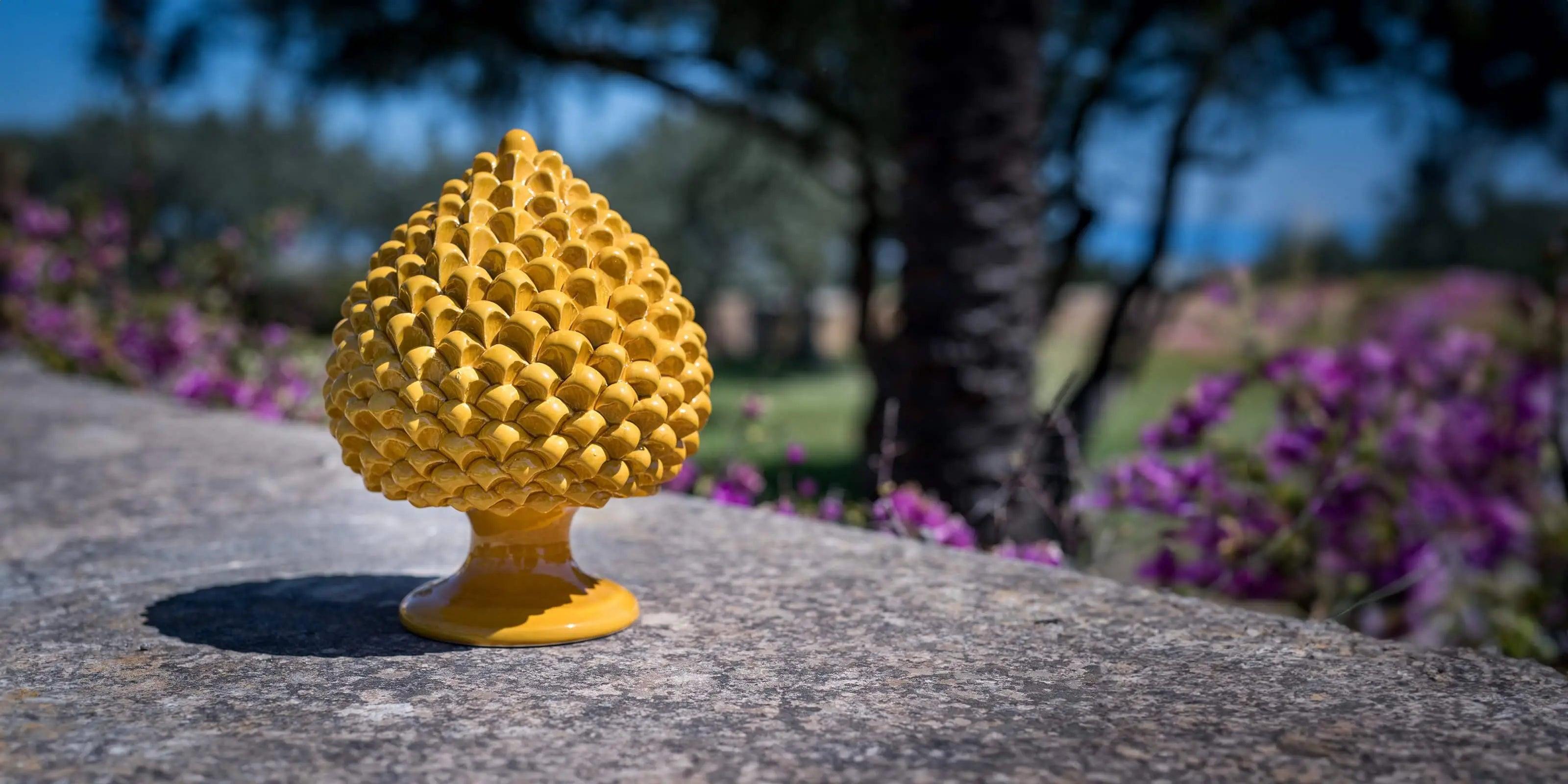
Round, pointed, often glazed in blue or in green and gold: the pigna (Sicilian ceramic pinecone) is the good-luck symbol par excellence. It represents prosperity, fortune, health and hospitality, and for this reason it is given to those moving into a new home, to newlyweds, to the people we love. In Mediterranean tradition the pinecone recalls fertility and even immortality, because it stays beautiful and intact for a long time. It is no coincidence that you find it on gate pillars, on rooftops and on the tables of Sicilian homes: it is a silent blessing that watches over the house.
Read more → Sicilian pigne: traditional, handcrafted decorations · Discover the Pigna-shaped collection →
The Trinacria
The symbol that appears even on the Sicilian flag is the Trinacria: a head of Medusa at the centre, from which three bent legs radiate. The three legs represent the island's three geographical corners (Capo Peloro to the north-east, Capo Passero to the south, Capo Lilibeo to the west), and recall the ancient Greek name of Sicily, Trinacria, the "land of three promontories". The ears of wheat that often accompany the image point to the fertility of a land that was Rome's granary of the Empire. It is the oldest and most identity-defining symbol, and in ceramics it returns as an emblem of belonging.

Read more → Medusa Head: from Greek myth to Caltagirone ceramics
An Itinerary Through the Places of Art
Ceramics are not born in a vacuum. They are born of a landscape, of a quality of light, of towns that have made beauty a reason for living. Here are four stops that, together with Caltagirone, make up a journey through the Sicily of art.
Taormina, the Balcony over the Sea
Suspended between the sky and the Ionian Sea, with Etna as its backdrop, Taormina is Sicily at its most elegant. Its Ancient Theatre, Greek in plan and Roman in structure, is perhaps the most spectacular stage in the world: behind the columns, the volcano and the sea. Along Corso Umberto, among the medieval palazzi, craft workshops display ceramics and objects that speak of the whole island. Taormina is the place where travellers of every era have sought, and found, the very idea of Sicily.
Coming soon: "Taormina: what to see and where to find Sicilian craftsmanship"
Siracusa and Ortigia
Siracusa was one of the most powerful cities of the Greek world, home to Archimedes. Its heart is Ortigia, the island linked to the mainland by just a few bridges, a labyrinth of Baroque alleys that suddenly open onto Piazza Duomo, where a cathedral is literally built inside a Greek temple dedicated to Athena. Here myth is not the past: it is living stone, the same material from which, centuries later, ceramics drew their figures.
The Baroque Val di Noto
In 1693 an earthquake razed south-eastern Sicily to the ground. Out of the catastrophe came one of the most extraordinary urban experiments in history: the rebuilding of an entire region in the late Baroque style. Noto, Modica, Ragusa Ibla, together with Caltagirone itself, today form the UNESCO site of the Late Baroque Towns of the Val di Noto, recognised in 2002. Undulating façades, monumental stairways, honey-coloured churches: it is the most theatrical Baroque there is, and ceramics share that same love of decoration and wonder.
Etna and Lava Stone
Above it all she looms, Etna, the highest and most active volcano in Europe. Her presence is not only landscape: it is material. From cooled lava comes lava stone, which artisans cut, glaze and hand-paint until it becomes tabletops and furnishing surfaces of extraordinary durability. It is the purest example of how, in Sicily, nature becomes design.
Discover the Lava stone tables collection → · in-depth piece "Etna and lava stone" coming soon.
Festivals and Traditions That Bring Ceramics to Life
In Sicily, craftsmanship does not live in museums: it lives in the festivals. It is in the celebrations that ceramics find their deepest purpose, between the sacred and the everyday.
Christmas, in Caltagirone, has a scent all its own. The town is the home of the handmade nativity scene: the pastori (nativity figures) in terracotta and hand-painted ceramic are a tradition handed down for generations, and composing one's own nativity scene is a ritual that brings families together. In the same season, the Staircase lights up and the shop windows fill with decorations.

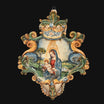
Large Sicilian Holy Water Font 25×35 cm / 9¾×13¾", Madonna and Child, Tricolore – Sicilian religious tradition from Caltagirone
Acquista ora
Large Sicilian Holy Water Font 25×35 cm / 10×14", Madonna and Child, Tricolore – Italian devotional ceramic from Caltagirone, Sicily
Acquista ora
Medium Sicilian Holy Water Font 19×30 cm / 7½×11¾", Madonna and Child, Tricolore – Sicilian sacred craftsmanship from Caltagirone
Acquista ora
Small Sicilian Holy Water Font 15×25 cm / 5¾×9¾", Madonna and Child, Tricolore – Sicilian sacred craftsmanship from Caltagirone
Acquista oraPatron-saint festivals punctuate the year with a unique theatricality: Sant'Agata in Catania in February, among the largest religious celebrations in the world; Santa Rosalia in Palermo in July; and the Luminaria di San Giacomo in Caltagirone already mentioned. In each, the art of ceramics accompanies devotion, from holy water fonts to votive offerings.
Coming soon: "Sant'Agata in Catania and the great festivals of the Sicilian calendar"
From Material to Interiors: Sicilian Ceramics Today
It would be a mistake to think of Caltagirone ceramics as something purely ancient. The tradition is alive precisely because it knows how to speak to the present. In recent years Sicilian maiolica has entered the world of design and interiors with force, championed too by the great fashion houses that have made it a contemporary icon.
For an architect or an interior designer, a piece of Sicilian ceramic is far more than a decorative object: it is an element that brings identity, warmth and a story to tell the client. A pair of Teste di Moro in a hotel lobby, a lava stone top in a restaurant, a wall of maiolica in a villa: these are choices that transform an anonymous space into a place with a soul. This is where handcrafted production shows its advantage over the industrial one, namely the ability to customise formats, colours and decorations to the exact measure of the project.
This interest does not stop at the island's shores. Caltagirone ceramics are now present at the great international design and furnishing fairs, from Maison&Objet in Paris to the showcases of Made in Italy around the world, where the international public recognises in them a value that goes beyond the object: the story of a territory and the signature of a hand. For those who live far from Sicily, owning one of these works means keeping an authentic fragment of the island close.
For bespoke projects, hospitality and contract supplies, samples and technical sheets, you can contact the workshop directly. Discover how we work → Stages of production · About us →
Would you like to see the works in person? In Caltagirone you can visit our workshop, where Sicilian ceramics take shape, and our showroom, where the collections are on display.
How to Recognise and Take Home Genuine Caltagirone Ceramics
With fame come imitations too. Telling a genuine Caltagirone ceramic apart from an industrial piece is not difficult, if you know what to look for.
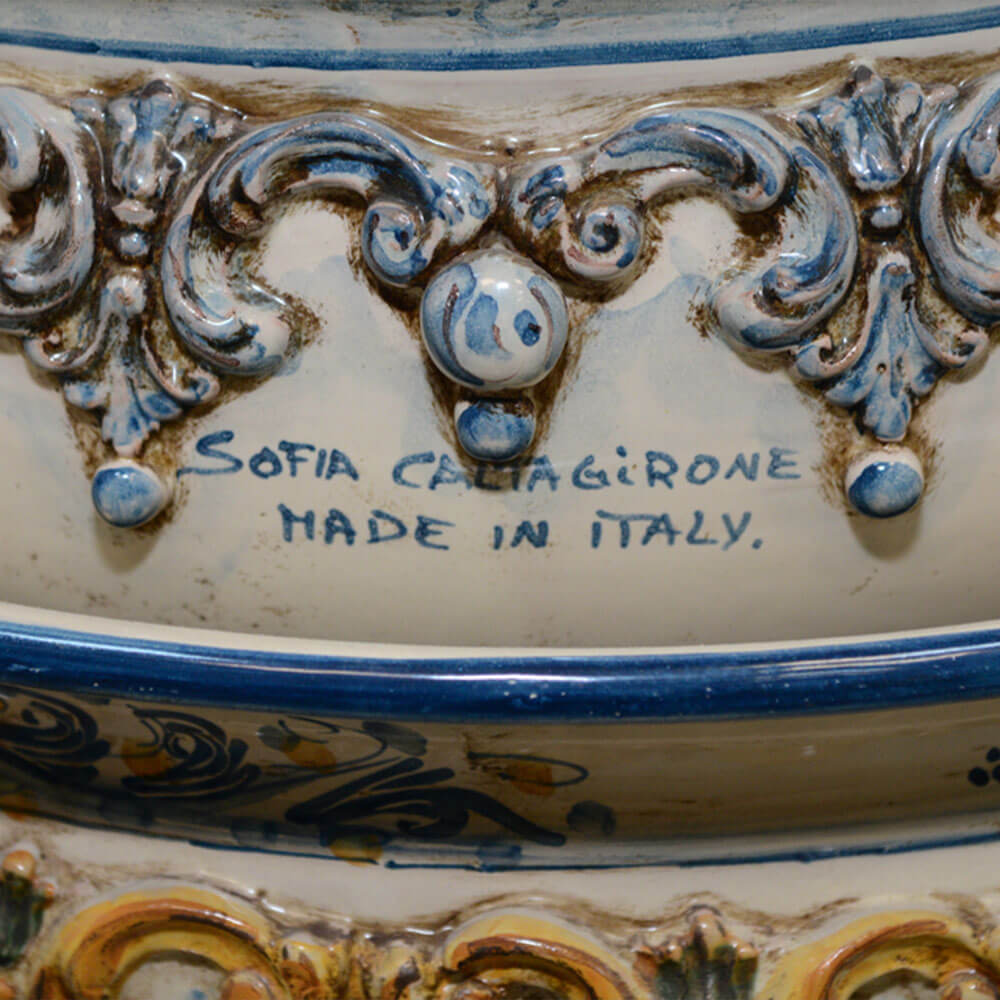
The first sign is the hand. An authentic piece of maiolica is modelled and painted by hand, and that means no two pieces are identical. The small irregularities in the brushstroke, the tiny differences in colour, even the occasional slight imperfection, are not flaws: they are the artisan's signature, the proof that there is a person behind the piece and not a mould. The second sign is the decoration. The traditional motifs and characteristic colours, that blue, that yellow, that green, follow a precise grammar that a trained eye recognises. The third is provenance: buying directly from a Caltagirone maker is the most solid guarantee of all.
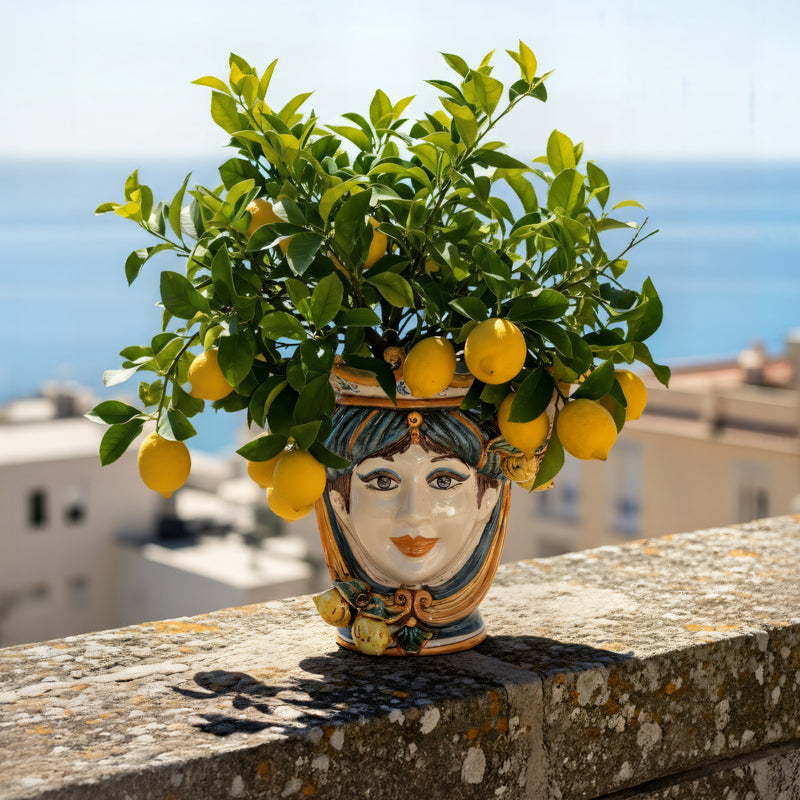
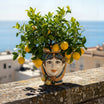
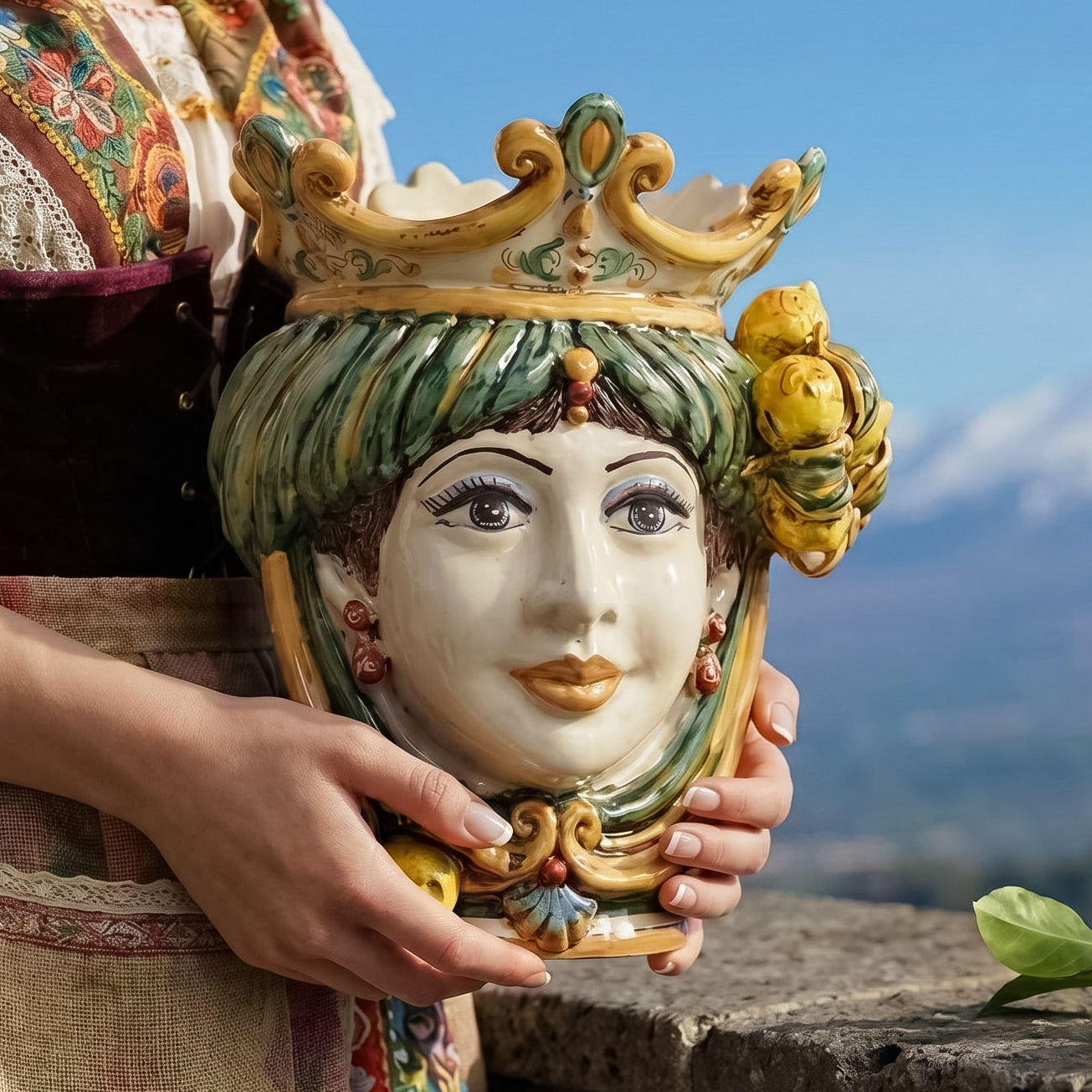
Sicilian Moor's Head with Lemons H 25 cm / 9.8", Woman, Blue and Orange – Testa di Moro from Caltagirone, Sicily
Acquista ora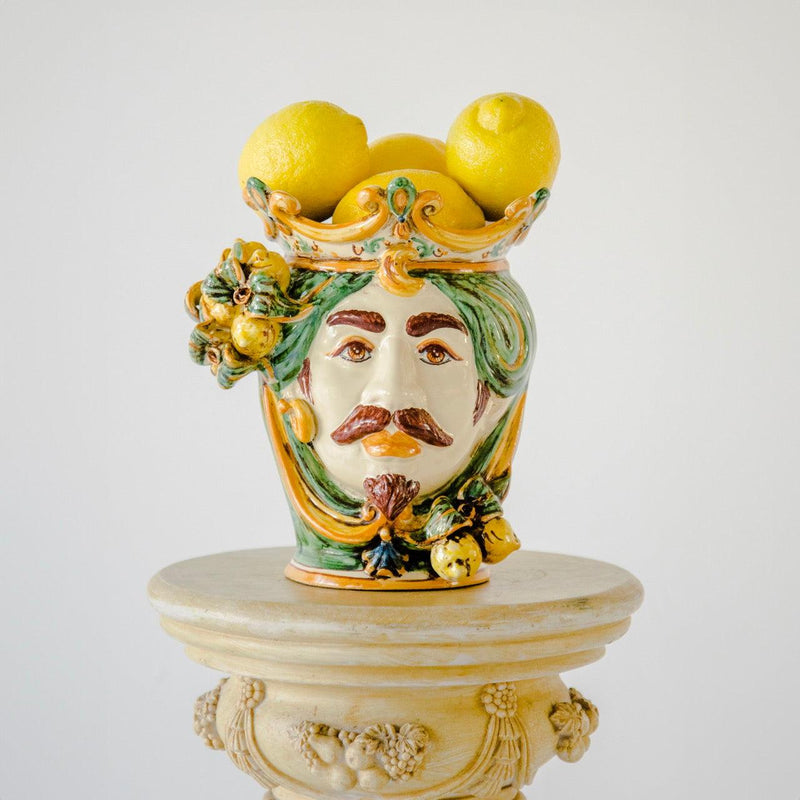
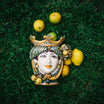
Sicilian Moor's Head with Lemons H 25 cm / 9.8", White Man, Green and Orange – Testa di Moro from Caltagirone, Sicily
Acquista ora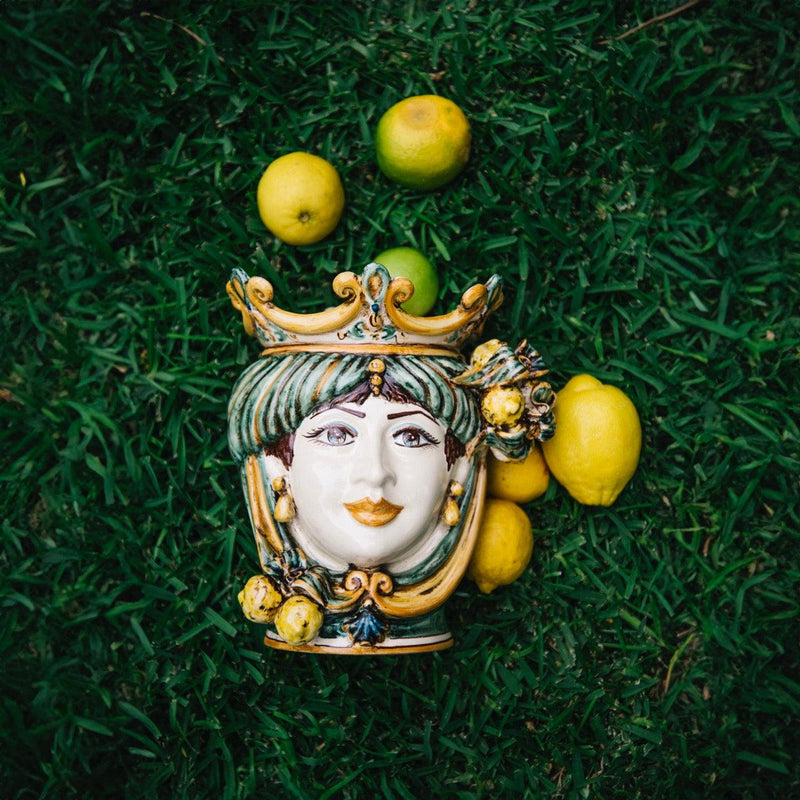
Sicilian Head Vase with Lemons H 25 cm / 9.8", Woman, Green and Orange – Testa di Moro from Caltagirone, Sicily
Acquista ora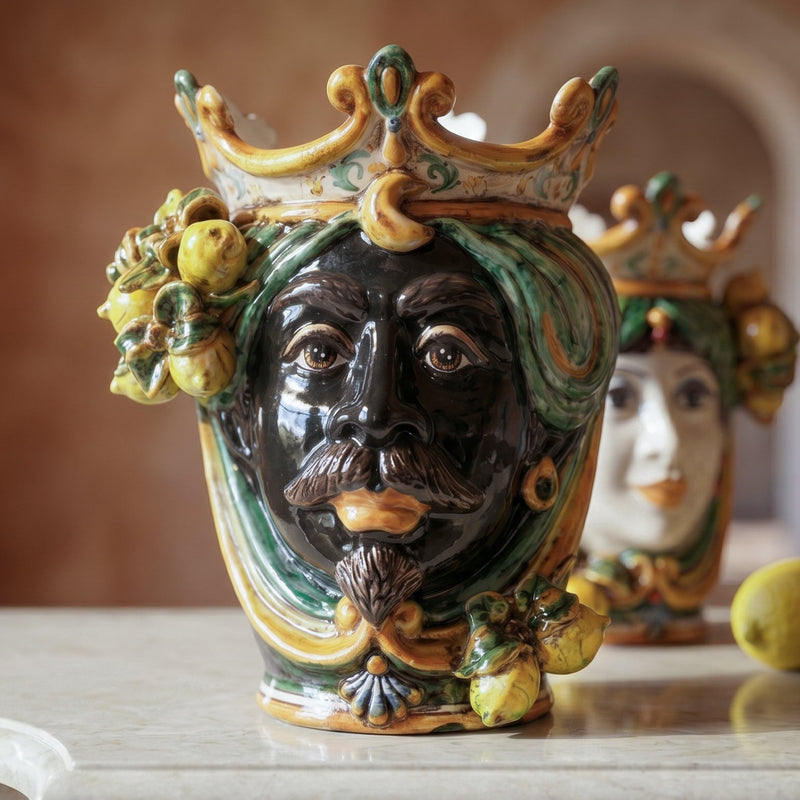
Sicilian Head Vase with Lemons H 25 cm / 9.8", Moro Male, Green and Orange – Testa di Moro from Caltagirone, Sicily
Acquista oraRecognising the authentic is not only a matter of taste, but also of value. A handmade ceramic is a small investment of the heart and, often, of money too: it does not wear out with trends, it does not lose meaning over time, and indeed it gains character as it becomes part of a home's story. This is the difference between buying an object and choosing a work of art. Those who collect Caltagirone ceramics know it: behind every piece there are a territory, a technique and a person, and this is exactly what no industrial production could ever replicate.
Complete guide → How to recognise genuine Caltagirone ceramics
Sicily Is to Be Lived, and Then Taken Home
At the end of this journey a simple idea remains: Sicily is not to be visited, it is to be lived. You live it climbing the maiolica steps of Caltagirone, losing yourself among the Baroque alleys of Ortigia, watching Etna smoke behind the Theatre of Taormina. And you go on living it afterwards too, when an object born of that land enters your home and carries with it the memory of an emotion. If you have the chance to come to Sicily, do it: no photograph captures the intensity of these places. And if you already carry Sicily in your heart, a hand-painted ceramic is the most authentic way to keep it close every day.
🏺 Take Home a Piece of Sicily
Every work by Ceramiche di Caltagirone Sofia is modelled and painted entirely by hand in our workshop, where tradition and design meet. We ship throughout Italy and all over the world with insured shipping. Explore our collections →
Frequently Asked Questions
Where is Caltagirone? Caltagirone lies inland in south-eastern Sicily, in the province of Catania, about an hour's drive from the provincial capital. It is part of the UNESCO site of the Late Baroque Towns of the Val di Noto.
Why is Caltagirone famous for ceramics? The town boasts a thousand-year ceramic tradition, favoured by the wealth of clays in the area and by the glazing techniques introduced by the Arabs in the 9th century. Its very name, from the Arabic Qal'at al-Ghiran, means "fortress of vases".
What is the difference between handmade and industrial ceramics? Handmade ceramics are modelled and painted by an artisan: every piece is unique and the small irregularities testify to its authenticity. Industrial ceramics are mass-produced with moulds, uniform and lacking that artistic value.
What do the Teste di Moro and the Sicilian pigna mean? The Teste di Moro come from an ancient love legend and symbolise Sicilian passion. The pigna is a symbol of good fortune, prosperity and hospitality, traditionally given for a new home and for weddings.
Can I buy Caltagirone ceramics online and receive them abroad? Yes. Ceramiche Sofia ships all over the world with protective packaging and insured shipping. Shipping times and costs →





Comment
Note: comments must be approved before being published.
This site is protected by hCaptcha and the hCaptcha Privacy Policy and Terms of Service apply.